

What Is Segment?
Ask ten marketers what “Segment” means and you’ll probably get ten slightly different answers — a tracking tool, a data pipe, “the thing our dev team set up years ago that nobody wants to touch.” All of them are half right.
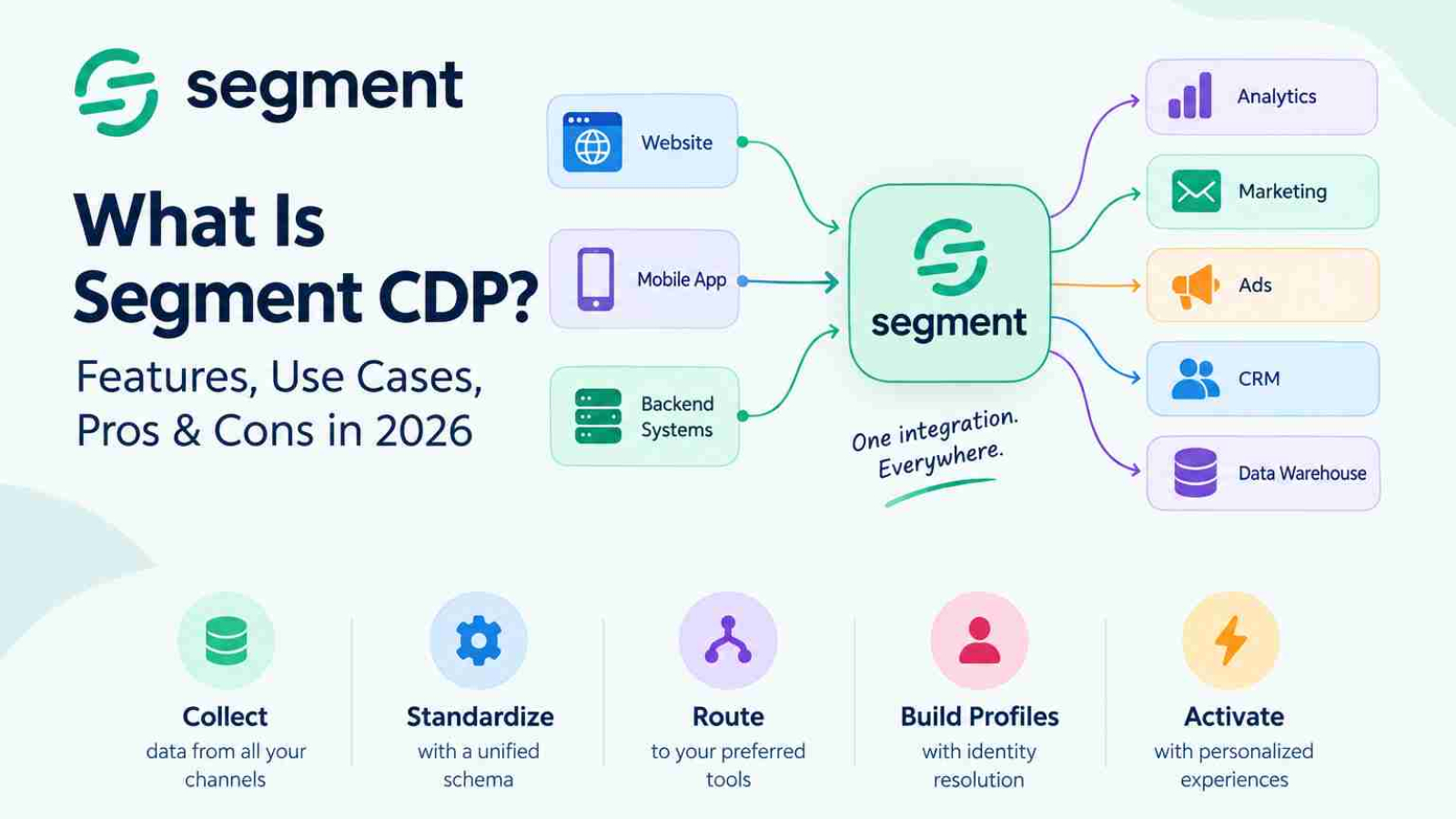
Segment is a customer data platform (CDP) — software that sits between the places your customers interact with your brand (your website, mobile app, backend systems) and the tools your teams rely on every day (analytics dashboards, email platforms, ad networks, CRMs). Instead of building a separate integration for every single tool, you send data to Segment once, and it routes that data wherever it’s needed.
Founded in 2011 and acquired by Twilio in 2020, Segment has spent over a decade becoming one of the most widely used CDPs in the market — used by companies ranging from early-stage startups to enterprise brands.
Quick Summary (TL;DR)
- Segment is a customer data platform that collects, standardizes, and routes customer data.
- It runs on a single-API model: instrument once, send data everywhere.
- Its four core products are Connections, Protocols, Unify, and Engage.
- It’s strong at event collection but has a more rigid data structure than warehouse-native alternatives.
- It suits teams that want fast, standardized data collection without heavy engineering lift.
How Segment Works, in Plain English
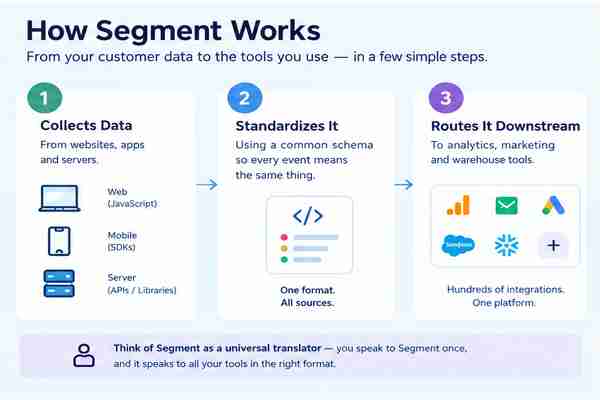
Strip away the jargon and Segment does three things:
- Collects data — from websites (JavaScript libraries), mobile apps (SDKs), and servers (APIs or backend libraries).
- Standardizes it — using a defined schema so an “event” means the same thing no matter which source sent it.
- Routes it downstream — to whichever mix of analytics, marketing, and warehouse tools your business uses.
Picture a universal translator sitting between your product and your tool stack. You speak to Segment in one consistent format; Segment speaks to hundreds of destination tools in whatever format each one expects.
The Four Core Products
Product | What It Does |
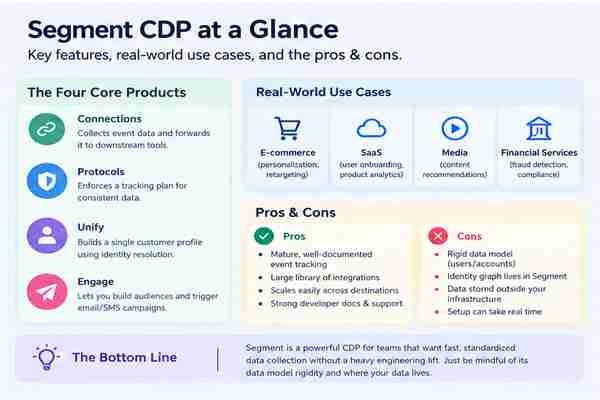
Connections | Collects event data from apps, websites, and servers, then forwards it to downstream tools |
Protocols | Enforces a tracking plan so data stays consistent across every source |
Unify | Builds a single customer profile per person using identity resolution |
Engage | Builds audiences and triggers email/SMS campaigns based on behavior and traits |
Most companies start with Connections alone — getting reliable data flowing — before layering on Unify and Engage as their data maturity grows.
Data Collection: Client-Side vs. Server-Side
Segment supports two collection methods, and knowing the difference matters:
- Client-side tracking happens on the user’s device — a page view, a button click, an add-to-cart action. It uses Segment’s open-source Analytics.js library on web and dedicated SDKs on mobile.
- Server-side tracking happens from your own backend. It’s useful for capturing offline events or sensitive data you don’t want exposed in a browser, and it uses Segment’s backend libraries or a raw HTTP API.
Because tracking happens at the event level, Segment excels at behavioral data — but it wasn’t originally built to sit on top of a data warehouse, which matters for the next point.
Where Your Data Actually Lives
This is worth understanding before you commit to any CDP. Event data collected through Connections is archived indefinitely, but the data behind Unify and Engage — profiles, traits, computed audiences — sits in Segment’s own managed infrastructure, typically retained for a few years rather than indefinitely.
Two practical implications:
- Ownership: your unified customer profiles live in Segment’s systems, not your own warehouse.
- Compliance: because data sits outside your own cloud environment, meeting regulations like GDPR takes extra diligence on your end.
Identity Resolution: One Person, One Profile
One of Segment’s genuinely useful capabilities is identity resolution — recognizing that the anonymous visitor who browsed your site last week and the logged-in customer today are the same person. Segment matches identifiers like user IDs, anonymous IDs, and email addresses across every incoming event, then merges them into a single profile.
Where it has limits:
- Matching relies on exact identifiers, not fuzzy or probabilistic matching.
- The identity graph is fully managed by Segment — you can’t easily restructure the underlying logic yourself.
- Data models outside the standard “user” or “account” structure (households, subscriptions, multi-entity businesses) can be awkward to represent.
Building and Activating Audiences
Once profiles exist, Segment’s Engage product lets non-technical marketers build audiences through a visual interface — filtering by events, traits, or computed metrics (say, “customers who spent over $500 in the last 90 days”). These audiences then sync to ad platforms, email tools, or CRMs on a scheduled basis.
By default, audiences typically refresh roughly every eight hours, and syncing runs on a batch cycle rather than instantly — a detail worth knowing if your use case depends on split-second personalization.
Pros and Cons at a Glance
Pros | Cons |
Mature, well-documented event tracking | Data model is fairly rigid (built around users/accounts) |
Large library of ready-made integrations | Identity graph lives entirely inside Segment |
Scales easily across many destinations | Data is stored outside your own infrastructure |
Strong developer documentation and support | Initial setup and implementation can take real time |
Key Takeaways
- Segment is a customer data platform, not just an analytics tool — it collects, standardizes, and routes customer data across your stack.
- Its four products — Connections, Protocols, Unify, Engage — cover collection, governance, identity resolution, and activation.
- It’s a strong fit for teams that want to move fast without a heavy engineering lift.
- Its main tradeoffs are a less flexible data model and data living outside your own warehouse.
- Weighing these tradeoffs upfront helps you decide whether Segment, or a warehouse-native alternative, fits your data strategy better.
Summary
Segment solved a real, common problem: businesses were drowning in one-off integrations between marketing and analytics tools, with no clean way to collect data once and send it everywhere. That value proposition still holds today. Whether it’s the right long-term fit depends on how much control you need over where your data lives, how complex your customer model is, and how real-time your activation needs really are — questions worth answering before you commit engineering time to any CDP.
Add a Comment